Health Insurance Ownership and Factors Related to the Utilization of Health Services in Blitar, East Java, Indonesia
DOI:
https://doi.org/10.26911/thejhpm.2026.11.02.09Abstract
Background: Blitar City, Indonesia, aims to achieve 99.74% universal health coverage (UHC) by 2024. However, public health services are only accessible to 34.6% of the population. Utilization of services for non-communicable diseases such as hypertension remains below 20%. The aim of this research was to analyze the relationship between health insurance ownership, predisposing factors, and supporting factors on the utilization of health services.
Subjects and Method: This was a cross-sectional study design and involved 405 respondents in Blitar City, East Java, Indonesia. Data collection was conducted using a structured questionnaire instrument measuring demographic characteristics, socioeconomic status, health status, health insurance ownership, and psychological behavioral aspects (self-efficacy, attitude, and intention) rated on a Likert scale. Data were analyzed using a structural equation modeling (SEM) approach for path analysis.
Results: Path analysis revealed five main factors that significantly influenced healthcare utilization. Directly, gender (b=0.15; CI 95%=0.05 to 0.26; p=0.005), marital status (b=0.13; CI 95%=0.02 to 0.24; p=0.017), and behavioral intention (b=0.07; CI 95%=0.03 to 0.12; p=0.003) had a significant positive effect. Indirectly, self-efficacy was the most dominant positive predictor of behavioral intention (b= 0.54; CI 95%=0.49 to 0.59; p<0.001), followed by behavioral attitude (b=0.09; CI 95%= 0.02 to 0.15; p=0.009).
Conclusion: Self-efficacy, gender, marital status, attitudes, and intentions are dominant factors. The government needs to simplify digital systems, optimize men's health programs, and transform service quality to keep pace with the high pace of UHC achievement.
Keywords:
health insurance, health services, path analysis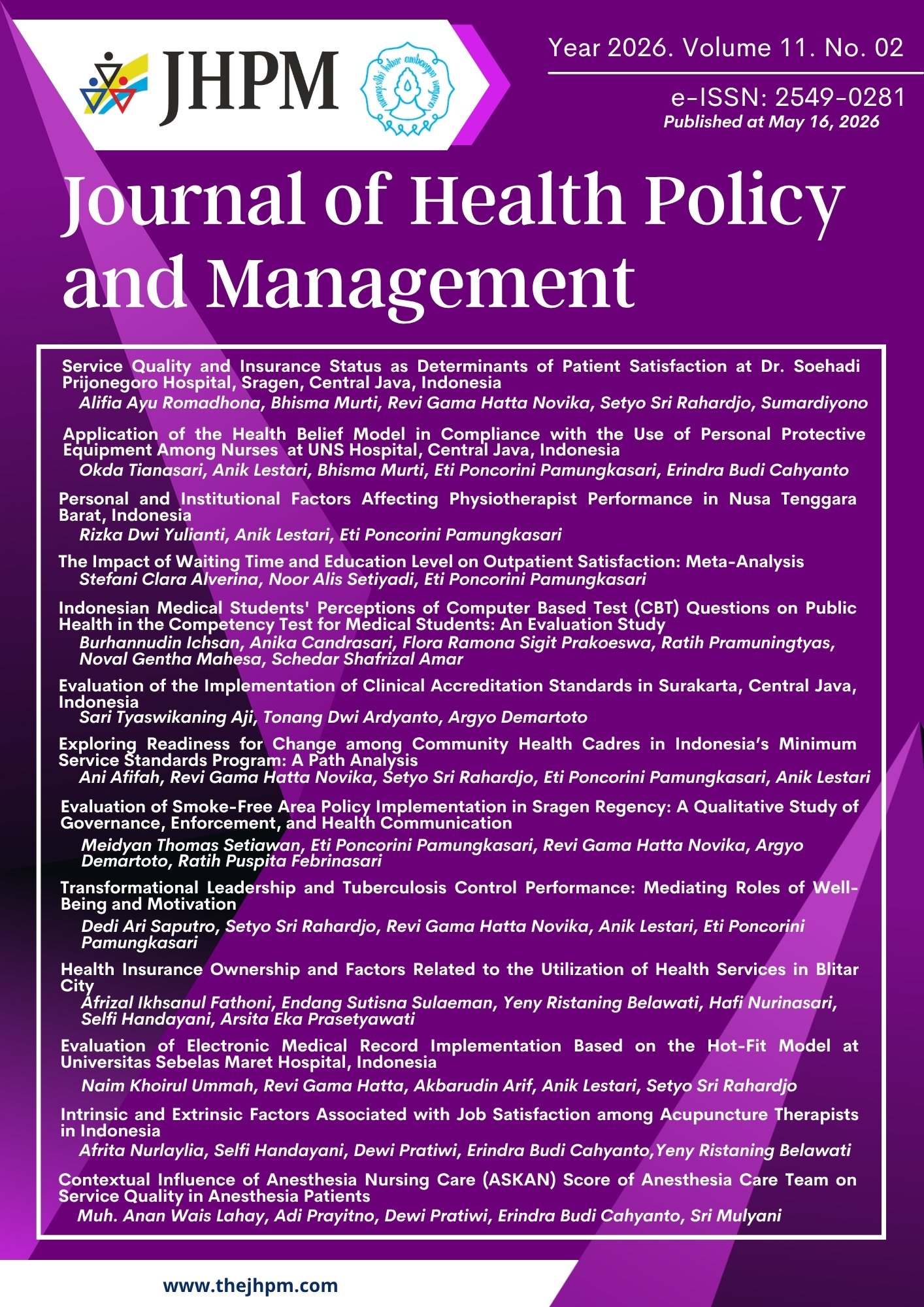
How to Cite
References
Ajzen I (2020). The theory of planned be-havior: Frequently asked questions. Hum Behav Emerg Technol. 2(4):314–324. https://doi.org/10.1002/hbe2.195.
Akhriansyah M, Ester, Langelo W, Immawanti, Aji R, Anugrah AK, Sya-rif I, Dasat M, Haris, Wiratikusuma Y, Nulhakim L, Budiawan H, Samiun Z (2023). Family nursing. Padang: Get Press Indonesia
Alayda NF, Aulia CM, Ritonga ER, Purba SH (2024). Literature review: analyz-ing the impact of the national health insurance (JKN) policy on access and quality of health services. J Kolaborati Sains. 7(7):2616–2626. https://doi.org/10.56338/jks.v7i7.5573
Amayu R, Hasyim H, Syakurah RA (2024). Literature review: Implementation of the referral-back program (PRB) sys-tem among National Health Insur-ance participants at primary healthcare facilities. Mitra Raflesia (J Health Sci). 16(2):141–149. https://doi.org/10.51712/mitraraflesia.v16i2.451.
Andersen RM (2008). National health sur-veys and the behavioral model of health services use. Med Care, 46(7):647-53. doi: 10.1097/MLR.0b013e31817a835d.
Blitar City Health Office (2024a). Health profile of Blitar City 2024. Blitar: Blitar City Health Office.
Blitar City Health Office (2024b). Health profile of Blitar City 2024: Analysis of healthcare facility utilization and gaps in Universal Health Coverage (UHC). Blitar: Blitar City Government.
Blitar City Health Office (2024c). Health profile of Blitar City 2024: Assessing Universal Health Coverage (UHC) achievements and the effectiveness of public health services. Blitar: Blitar City Government.
East Java Provincial Health Office (2024). Health profile of East Java Province 2024: Accelerating Universal Health Coverage at the district/city level. Su-rabaya: East Java Provincial Govern-ment.
Health Development Policy Agency (2024a). Report on disparities in health insurance coverage and healthcare service utilization in Indo-nesia. Jakarta: Ministry of Health of the Republic of Indonesia.
Health Development Policy Agency (2024b). Thematic report of the 2023 Indonesian Health Survey (SKI): Dis-parities in health insurance coverage and healthcare service utilization in Indonesia. Jakarta: Ministry of Health of the Republic of Indonesia.
Ismainar H, Paramita KW, Yusuf M, Yashir M, Asriati, Yusrawati, Manik SE, Dewi ST, Saepudin M, Aryani D, Pritami RF, Indrawati L, Harun MF, Salim NA, Sembiring DA (2024). Community health center and hospi-tal management. Purbalingga: Eureka Media Aksara.
Kumala CM, Susanti, Mildawati R, Ginting MNK, Meliana, Widodo STM, Sya'diah Y, Fatmawati EN (2025). Health promotion and behavioral sci-ence. Padang: Akiopedia Press
Laksono AD, Wulandari RD, Ipa M, Sillehu S, Megatsari H, Senewe FP, Latifah L, Ashar H, Rohmah N, Khoiri A, Purwoko S (2024). Utilization of health services in underdeveloped, border, and island areas. Makassar: Persakmi
Marissa AN, Maqfirah AA, Hanifah AU, Priscilla MA, Amalia F (2026). Analy-sis of inequality in access to healthcare services between western and eastern Indonesia. J Kesehat Tambusai. 7(1):1103–1114. https://doi.org/10.31004/jkt.v7i1.53077
Mboi N, Murty Surbakti I, Trihandini I, Elyazar I, Houston Smith K, Bahjuri Ali P, Kosen S, Flemons K, Ray SE, Cao J, Glenn SD, Miller-Petrie MK, Mooney MD, Ried JL, Nur Anggraini Ningrum D, Idris F, Siregar KN, Ha-rimurti P, Bernstein RS, Pangestu T, Sidharta Y, Naghavi M, Murray CJL, Hay SI. On the road to universal health care in Indonesia, 1990-2016: a systematic analysis for the Global Burden of Disease Study 2016. Lancet. 2018 Aug 18;392(10147):581-591. doi: 10.1016/S0140-6736(18)30595-6. Epub 2018 Jun 28. PMID: 29961639; PMCID: PMC6099123.
Pramesti AD, Kurniawati A, Wardani AK (2022). The impact of insurance us-age on healthcare services. HIMIE Economics Research and Olympiad (HERO), 1(1), 185–191. Retrieved from https://prosiding.umy.ac.id/hero/index.php/hero/article/view/28
Ramli M (2022). Preferences of male and female patients in choosing health service facilities at Puskesmas Kassi-Kassi. J Predestination. 2(2):90–101. https://dx.doi.org/10.26858/prd.v2i2.33322.
Sheeran P, Webb TL (2016). The intention-behavior gap. Soc Personal Psychol Compass. 10(9):503–518. https://doi.org/10.1111/spc3.12265.
Statistics Indonesia (2023). Health statis-tics profile 2023. Jakarta: BPS-Statistics Indonesia.
Sulaeman ES (2025). Models and theories of behavior change in public health. Surakarta: Sebelas Maret University Press.
Tumangger DTA (2021). Perceived need factor analysis on the utilization of el-derly health services in Puskesmas and Posyandu. J Kesehat Komunitas. 7(3):360–367. https://doi.org/10.25311/keskom.Vol7.Iss3.982.
United Nations (2015). Transforming our world: The 2030 agenda for sustaina-ble development. New York: United Nations.
World Health Organization (2015). Health in 2015: From MDGs to SDGs. Gene-va: World Health Organization.